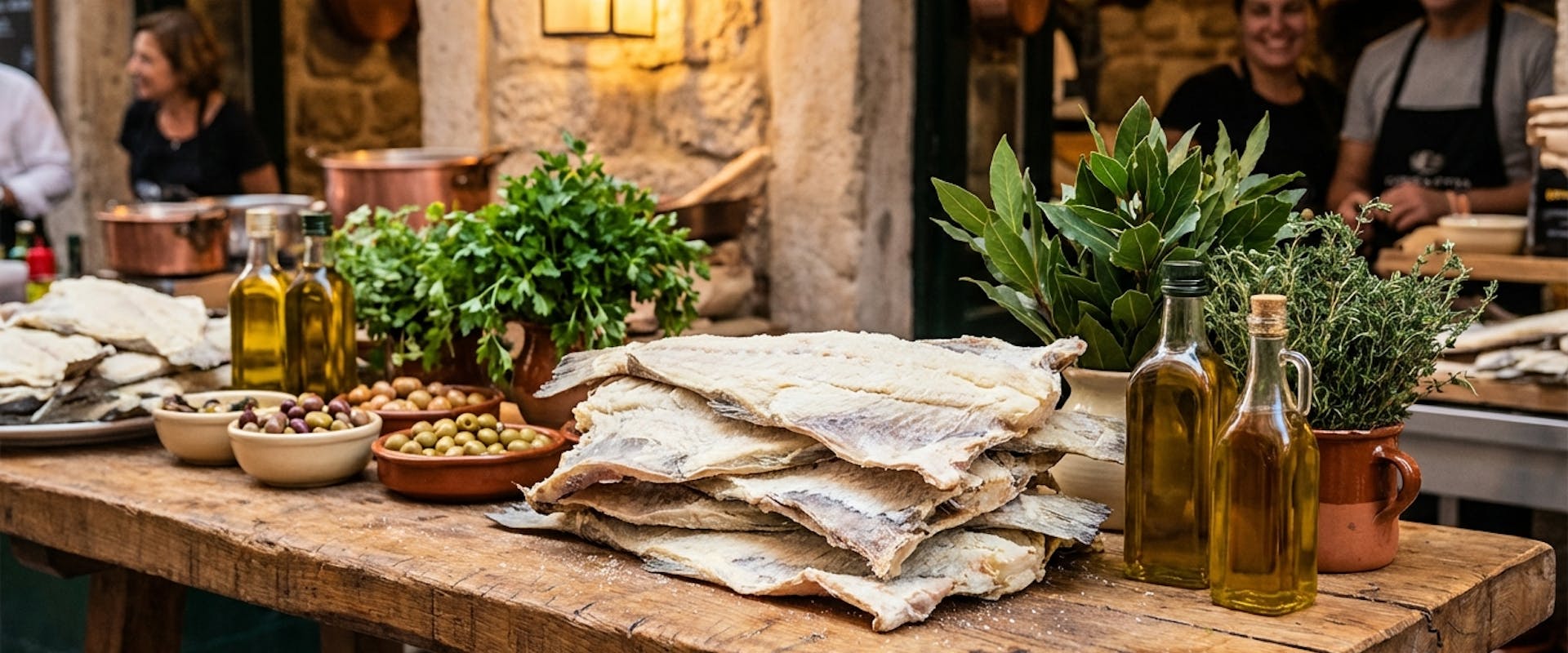

Bacalhau: Portugal's Salt Cod Obsession and 365 Ways to Cook It
Portugal has 1,800 kilometers of coastline and some of the world's freshest seafood, yet the country's most beloved fish arrives dried, salted, and stiff as cardboard. This is bacalhau—salt cod—and understanding Portugal's obsession with it means understanding the Portuguese soul itself.
The Paradox of Portuguese Cod
Here's the first mystery: Portugal doesn't have cod in its waters. The Atlantic cod (Gadus morhua) lives in cold northern seas—off Norway, Iceland, and Newfoundland. Portuguese fishermen spent centuries sailing to these distant waters, catching cod, and bringing it back preserved in salt.
The second mystery: Why would a country surrounded by fresh fish worship a preserved one?
The answer lies in history, economics, and the alchemy of salt preservation. Bacalhau sustained Portuguese explorers during the Age of Discovery. It fed the poor during lean times. And through centuries of necessity, it became national identity—"the faithful friend," as the Portuguese call it.
The Legend of 365 Recipes
Portuguese tradition claims there are 365 ways to prepare bacalhau—one for every day of the year. While the actual number might be debatable, the variety is not. From simple home cooking to elaborate restaurant presentations, bacalhau appears in countless forms.
The Essential Bacalhau Preparations
Bacalhau à Brás - Perhaps the most famous preparation, this Lisbon classic combines shredded salt cod with matchstick potatoes, scrambled eggs, olives, and parsley. It's comfort food elevated to art.
Bacalhau com Natas - "Cod with cream"—layers of flaked cod, potatoes, caramelized onions, and béchamel, baked until golden. Rich, indulgent, and dangerously addictive.
Bacalhau à Gomes de Sá - Named after its 19th-century Porto creator, this casserole features cod, potatoes, onions, eggs, and olives—simple ingredients producing extraordinary depth.
Bacalhau Espiritual - "Spiritual cod," a creamy dish with carrots, port wine, and cream that somehow transcends its simple components.
Pastéis de Bacalhau - Crispy cod fritters that appear everywhere from fancy restaurants to train station cafés. The ultimate Portuguese snack.
The Art of Desalinating Bacalhau
Before you can cook bacalhau, you must revive it from its mummified state. This process—desalting—separates casual cooks from committed ones.
The traditional method:
- Choose your piece carefully—look for thick fillets with white (not yellow) flesh
- Place in a large container with skin-side up
- Cover completely with cold water
- Refrigerate for 24-72 hours, changing water every 8-12 hours
- Taste a small piece—it should be pleasantly salty but not overwhelming
Timing matters: Thin pieces need 24 hours; thick loins might need 72. The Portuguese grandmother's trick? Taste the water after each change. When it stops tasting like seawater, the cod is ready.
Finding the Best Bacalhau in Portugal
Lisbon's Bacalhau Temples
Casa do Bacalhau (Alfama) - A restaurant entirely dedicated to cod, offering 43 different preparations. The walls display vintage bacalhau advertising, creating a museum-like atmosphere.
Laurentina (Avenidas Novas) - Family-run since 1976, serving traditional preparations in massive portions. Their Bacalhau à Lagareiro (cod baked with potatoes in olive oil) is legendary.
A Casa do Bacalhau (Baixa) - Don't confuse this with the Alfama restaurant—both are excellent, but this Baixa location focuses on classic home-style preparations.
Porto's Northern Approach
Porto's bacalhau tends toward simpler preparations that showcase the fish itself rather than elaborate sauces.
Casa Portuguesa do Pastel de Bacalhau - The name says it all. Their cod fritters set the standard for the entire country.
Cantinho do Avillez - José Avillez's casual spot serves innovative bacalhau preparations alongside traditional favorites.
Love Portuguese cuisine? Don't miss our guide to Lisbon's Pastel de Nata, exploring Portugal's most perfect pastry.
The Economics of Portuguese Cod
Portugal imports around 60,000 tons of salt cod annually—more per capita than any nation. Most comes from Norway now, though some still arrives from Iceland and Newfoundland's Grand Banks.
Good bacalhau isn't cheap. At Lisbon's markets, premium Norwegian cod can cost €15-25 per kilo. Cheaper alternatives exist, but quality matters enormously. Yellow-tinged fish or uneven salting produces inferior results.
Market shopping tips:
- Visit Mercado da Ribeira or Campo de Ourique market in Lisbon
- Ask for "bacalhau da Noruega" (Norwegian cod) for best quality
- Look for pieces with white flesh and no strong smell
- Buy pre-desalted cod for convenience, though purists insist on doing it yourself
Bacalhau at Home: Starting with Bacalhau à Brás
For first-time bacalhau cooks, à Brás offers the perfect introduction. The technique is forgiving, and the result delivers that authentic Portuguese experience.
Ingredients (serves 4):
- 500g desalted salt cod, shredded
- 500g potatoes, julienned into matchsticks
- 1 large onion, thinly sliced
- 4 cloves garlic, minced
- 8 eggs, beaten
- Handful of black olives
- Fresh parsley, chopped
- Olive oil for frying
- Black pepper to taste
The technique:
Fry the potato matchsticks in olive oil until golden and crispy. Remove and set aside. In the same pan, sauté onions until soft and sweet, about 10 minutes. Add garlic and shredded cod, cooking for 2-3 minutes.
Return the potatoes to the pan. Pour in beaten eggs and stir constantly over medium heat, scrambling gently. The eggs should create a creamy coating rather than discrete curds. Remove from heat while still slightly wet—they'll continue cooking from residual heat.
Garnish with olives and parsley. Serve immediately with crusty bread and a simple green salad.
The Cultural Weight of Bacalhau
No Portuguese Christmas is complete without bacalhau on Christmas Eve. Most families serve Bacalhau Cozido—simply boiled cod with potatoes, cabbage, and eggs, dressed in olive oil. It's deliberately humble, a dish of devotion rather than showmanship.
This tradition dates to Portugal's Catholic history, when meat was forbidden on holy days. Salt cod provided affordable protein that even poor families could serve on special occasions.
Beyond the Classics: Modern Bacalhau
Contemporary Portuguese chefs have reimagined bacalhau while respecting tradition. At Belcanto in Lisbon, Chef José Avillez serves cod with sea urchin and seaweed. At Yeatman in Porto, Chef Ricardo Costa creates bacalhau ravioli with shellfish bisque.
These innovations honor the ingredient while pushing boundaries. The best modern bacalhau dishes maintain that essential characteristic—they let the cod's unique texture and flavor shine through.
Exploring global preserved fish traditions? See how Japan approaches this craft in our Tokyo Ramen Guide featuring dried bonito and kombu.
The Future of Portuguese Bacalhau
Overfishing has changed the cod industry dramatically. The Grand Banks fishery collapsed in the 1990s. Norwegian and Icelandic cod are now farmed or strictly managed. This has driven prices up and made bacalhau less accessible to average Portuguese families.
Yet the tradition endures. Portuguese people still line up at markets before Christmas to buy their bacalhau. Restaurants still compete over who serves the best à Brás. And grandmothers still pass down their secret preparations to the next generation.
Lessons from the Faithful Friend
What strikes me most about Portugal's bacalhau culture is what it reveals about transformation. This dried, salted fish seems unpromising—stiff, gray, and decidedly dead-looking. But with patience, proper technique, and respect for tradition, it becomes something transcendent.
The Portuguese learned centuries ago that preservation doesn't mean settling for less. Sometimes the preserved version, treated with care and understanding, surpasses the fresh.
That's the lesson of bacalhau—that constraint breeds creativity, that necessity can become art, and that the most beloved dishes often come from making the most of what you have.
On my last night in Lisbon, I ate Bacalhau à Brás at a neighborhood tasca near Graça. The restaurant had no sign, just a few tables and an elderly woman cooking. Her à Brás was perfect—creamy eggs coating crispy potatoes and tender cod, finished with bright parsley.
"My grandmother's recipe," she said when I complimented it. "Everyone has their own way, but this is ours."
That's bacalhau in a sentence—everyone has their own way, but each way carries generations of Portuguese history, struggle, and love.
The faithful friend, indeed.